The heat pump vs gas hot water debate is one that our Sunshine Coast and Brisbane plumbers are getting asked to settle all the time these days – and for good reason.
Space-saving, fast-heating, never-ending gas instant systems have been the go-to upgrade choice for Queensland households for decades – and they earned that reputation. But heat pumps have been rising in popularity over the last two years, driven by federal rebates that have made them genuinely price-competitive upfront, and running costs that are reshaping the long-term numbers in their favour.
And there’s no doubt about it – both are great technologies. The question is which one is good for your specific situation.
We’ve designed this guide to walk you through that decision step by step. By the end, you should have a clear answer – or at least know exactly what to ask when you call us:
A quick refresher before we start
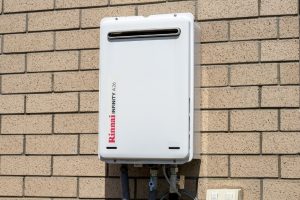
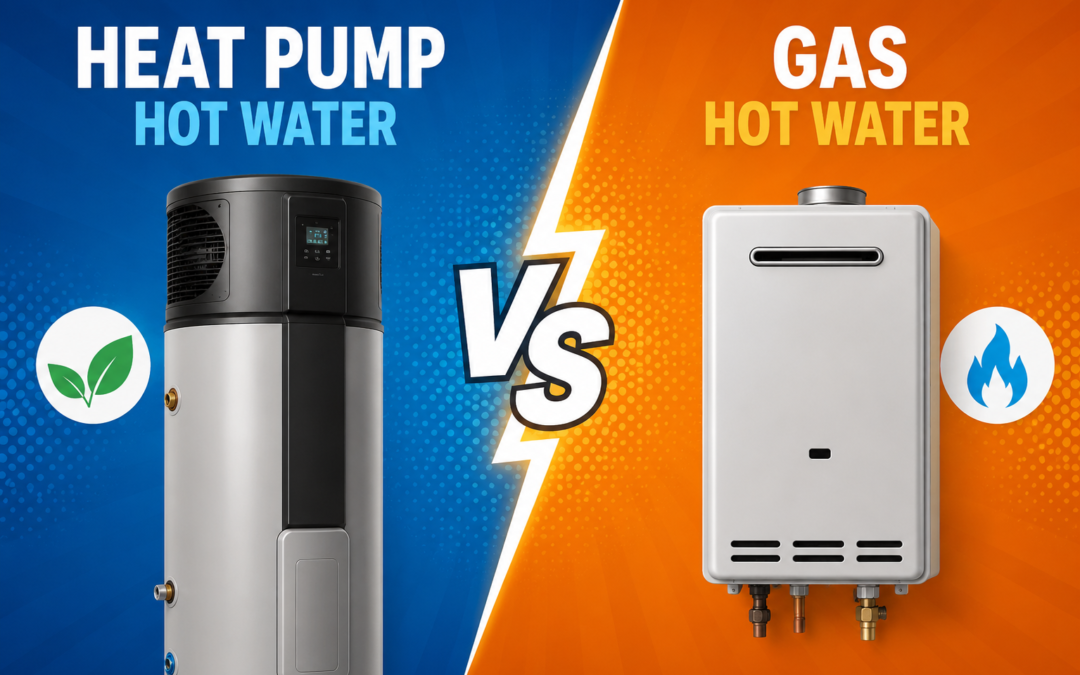
Gas instant systems heat water on demand using a gas burner. There’s no bulky storage tank, no standby heat loss, and hot water is available continuously as long as gas is flowing. They’re compact, fast, and reliable.
Heat pumps work very differently. They extract heat from the ambient air and use it to heat water stored in a tank – essentially a reverse refrigerator. They use electricity but consume significantly less of it than a standard electric storage system – typically around 70% less. They’re slower to heat than gas but work around the clock, keeping the tank ready.
Both sound pretty good, right? Walk through our 7 questions, though, and the right one for you may become abundantly clear:
1. Do you have gas connected?
This one might start it and end it for you! Because if your property doesn’t have a natural gas connection, a gas instant system means connecting to the mains – which involves infrastructure costs that can range from a few hundred to several thousand dollars depending on your proximity to the network.
And if you can’t connect to the mains at all, you’d have to run on LPG cylinders – which can certainly be done, and it’s completely reliable. But that carries ongoing cylinder costs that affect the running cost calculation significantly.
Already on gas? This question is easy. But if not, a heat pump sidesteps the connection question entirely and runs on your existing electrical supply.
2. What does your electricity situation look like?
The gas vs heat pump hot water calculation changes considerably depending on whether you have rooftop solar.
A heat pump charges its tank during the day – ideally during solar generation hours – which means households with panels can run their hot water almost entirely on free solar energy. The economics in that scenario are compelling: the system that was already cheaper to run becomes virtually free to run during daylight hours.
Without solar, a heat pump still uses significantly less grid electricity than a standard electric storage system, and on an economy tariff it can heat overnight at a reduced rate.
Gas instant doesn’t benefit from solar at all – it will always draw from the gas network regardless of what your panels are producing.
3. What’s your hot water demand like?
Gas instant systems shine under high simultaneous demand.
So ask yourself whether your household:
- Has multiple showers running at the same time?
- A large family with back-to-back morning routines?
- Commercial-adjacent usage?
Gas instant will handle peak demand like this without hesitation. Flow rate is measured in litres per minute, and a quality gas unit at 26L/min or 32L/min can serve almost any residential demand scenario without running cold.
Heat pump hot water vs gas becomes a tighter comparison for high-demand households because heat pumps rely on stored volume.
That means a correctly sized tank – typically 270-315 litres for a family of four – will handle normal daily demand comfortably, but an unusually heavy day can draw the tank down faster than the heat pump can recover.
For most households, this is never an issue. But for large families or those with unpredictable peak demand, it’s worth factoring in.
4. How much does running cost matter to you?
This is where the heat pump vs instant gas hot water equation gets really interesting. Because while gas instant is cheap to run relative to standard electric hot water storage, gas prices in Australia have risen significantly in recent years and are not expected to fall.
Heat pumps run on electricity, which has also risen, but the efficiency advantage is substantial – a heat pump delivers roughly three to four units of heat for every one unit of electricity consumed.
For a typical Sunshine Coast household, the heat pump hot water vs instant gas comparison on annual running costs generally favours the heat pump – particularly with solar panels in the mix.
Without solar, the gap narrows but the heat pump still typically edges ahead on running cost over the system’s lifetime.
5. What are the upfront costs?
A quality gas instant system installed typically runs between $1,500 and $2,500 – depending on the unit and installation complexity, that is.
A heat pump has historically cost more upfront, but the federal Small-scale Technology Certificates scheme reduces that gap with an upfront discount applied at the point of installation – typically worth $330 to $640 for Queensland households depending on the system and what it’s replacing.
It doesn’t close the gap entirely, but it makes the comparison closer than it used to be – and when you factor in the running cost difference over the system’s lifetime, the total cost of ownership picture often favours the heat pump.
Just check your eligibility before assuming gas is the more affordable upfront option – it may no longer be.
6. What about installation constraints?
Heat pumps need space – they’re larger than a gas unit and need adequate airflow around them to extract heat from the air effectively. They’ll work really well with a clear outdoor position, but a well-ventilated garage or side passage with good air movement can work fine too. A confined internal cupboard, however, is no good.
They also produce some noise during operation – comparable to a reverse-cycle air conditioner – which is worth considering if the installation point is near a bedroom or a neighbour’s fence. We’ve heard stories where installers don’t check the regulations and have to move an installation – even at the household’s expense!
Gas instant systems, on the other hand, are compact and can often go where an existing gas system was. If you’re replacing like for like and the gas connection is already in place, installation is usually straightforward.
7. How long are you planning to stay?
The gas hot water system vs heat pump decision looks different over a five-year horizon than a 15-year one. Heat pumps have a longer lifespan – typically 12-15 years or more – and the running cost advantage compounds over time. If you’re planning to stay in the property long-term, the total cost of ownership calculation almost always favours the heat pump.
But if you’re selling in 3 years, the upfront simplicity of gas instant may suit your situation better.
Still not sure?
That’s exactly what we’re here for. Static Plumbing’s licensed and friendly hot water plumbers work with Sunshine Coast and Brisbane homeowners every day to match the right system to the right household – including walking you through current rebate eligibility before you commit to anything.
Get in touch for an obligation-free quote.